
In drug development, a molecule’s three-dimensional structure is everything. Many drug molecules are chiral. One enantiomer (the eutomer) may provide the desired therapeutic effect, while the other (the distomer) could be inactive or cause harmful side effects. This fact makes optical purity an important quality for safety and effectiveness. Global regulatory bodies like the FDA and EMA have stringent guidelines for single-enantiomer drugs. Therefore, effective chiral resolution and purification are necessary. These processes bridge the gap between a racemic synthesis and the high-purity pharmaceutical intermediates required for modern medicine.
Classical Chemical Resolution: Diastereomeric Salt Formation
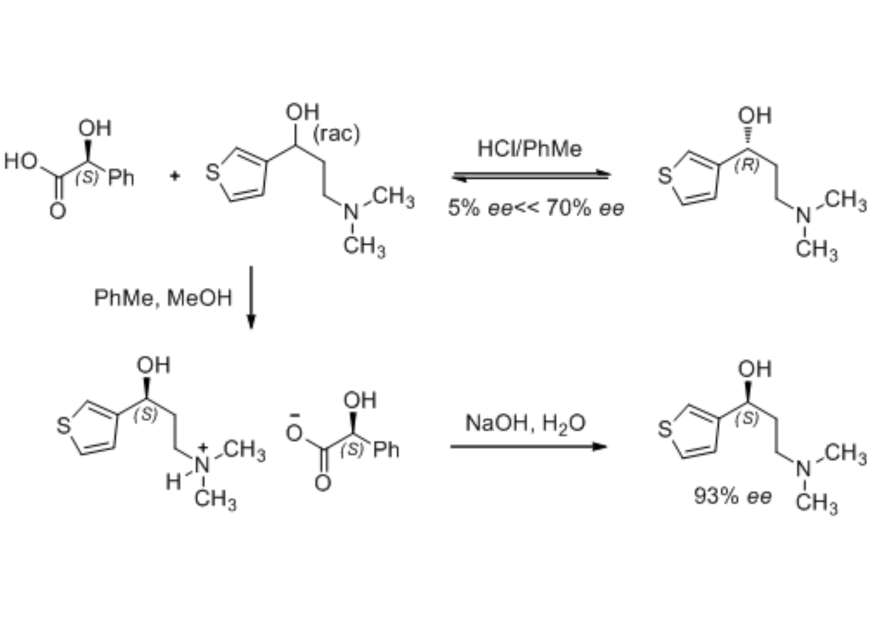
One of the most established and scalable methods for chiral resolution and purification is diastereomeric salt formation. This technique is a workhorse in industrial chemistry due to its robustness and cost-effectiveness.
Mechanism of Action
The process relies on a simple principle. Enantiomers have identical physical properties. However, when a racemic mixture of an acid or base reacts with a single enantiomer of a chiral resolving agent, it forms a pair of diastereomeric salts. Unlike enantiomers, diastereomers have different physical properties. This difference allows one diastereomeric salt to crystallize preferentially from a solution. After separation, chemists can reverse the salt formation to liberate the desired single enantiomer.
Common Resolving Agents and Process Optimization
Choosing the right resolving agent is key. Common choices include optically pure acids like (L)-Tartaric acid (C4H6O6) or bases like (S)-1-Phenylethylamine. To ensure commercial viability, we optimize the entire process. This includes selecting the ideal solvent, carefully controlling temperature to maximize yield, and developing methods to recycle the resolving agent.
Modern Chromatographic Chiral Resolution and Purification
Chromatography offers highly precise methods for separating enantiomers. Advances in this field have enabled separations that are both efficient and scalable.
High-Performance Liquid Chromatography (HPLC)
HPLC is a powerful tool for both analytical and preparative separations. The key to its success is the Chiral Stationary Phase (CSP). These specialized materials, packed into HPLC columns, create a chiral environment. As the racemic mixture passes through the column, one enantiomer interacts more strongly with the CSP than the other. Common CSPs include polysaccharide-based phases and macrocyclic antibiotic phases.
Supercritical Fluid Chromatography (SFC)
SFC represents a significant leap forward, especially for large-scale preparative chromatography. This technology uses a supercritical fluid, typically carbon dioxide (CO2), as the primary mobile phase. The benefits are numerous:
- Higher Throughput: SFC runs are much faster than traditional HPLC.
- Lower Solvent Consumption: Replacing organic solvents like acetonitrile (CH3CN) with CO2 makes the process greener.
- Easier Product Recovery: CO2 simply evaporates
For very high-volume commercial production, Simulated Moving Bed (SMB) chromatography provides a continuous purification process, further enhancing efficiency.
Biocatalysis and Kinetic Resolution
Nature provides some of the most selective catalysts available: enzymes. Biocatalysis harnesses these enzymes to perform highly specific transformations.
Enzymatic and Dynamic Kinetic Resolution
Kinetic resolution leverages the fact that enzymes often react much faster with one enantiomer than the other. For instance, a lipase can selectively hydrolyze an ester of one enantiomer. This allows for easy separation of the product and the remaining starting material.
Dynamic Kinetic Resolution (DKR) takes this a step further. It combines the selective enzymatic reaction with a catalyst that continuously converts the “unwanted” enantiomer into the desired one (racemization). This clever combination allows for a theoretical yield of 100% for a single enantiomer, a significant improvement over the 50% maximum of standard kinetic resolution.
Industrial Scale-Up and Quality Control
Translating a successful lab-scale separation to industrial production requires careful engineering and stringent quality control.
Crystallization Engineering and Analytical Validation
For methods like diastereomeric salt formation or enantioselective crystallization, the process must be tightly controlled. We manage everything from the initial “seed” crystal to large-scale industrial precipitation to ensure consistent particle size and purity. Analytical validation is very important all the time. We determine the enantiomeric excess (ee) using Chiral HPLC or GC and verify the absolute configuration with techniques like polarimetry.
Stability Monitoring
Once a pure enantiomer is isolated, it must remain pure. We conduct stability monitoring to ensure no racemization suppression techniques are needed and that the product’s chiral integrity is maintained during storage and subsequent downstream processing steps.
Sustainability and Ethical Manufacturing at Arbor Chemical
At Shanghai Arbor Chemical, we believe that advanced manufacturing and environmental responsibility go hand in hand. Our approach to chiral resolution and purification reflects this commitment. We develop processes for the efficient recovery of the “unwanted” enantiomer. We prioritize the use of green solvents and technologies like SFC to reduce our environmental footprint.
Our advanced manufacturing plants in Dalian and Anhui are equipped to handle these complex separations at scale. With strict quality controls and international certifications, we provide a reliable supply chain for our global partners.